How to Write a Character Your Readers Will Never Forget
To write a character people actually care about, you have to get inside their head first. What’s the one thing that drives every single decision they make? This is their core motivation, the engine humming away under the surface, built from their deepest wants, fears, and history.
Get this right, and everything else, their voice, their actions, their quirks, falls into place.
Building Your Character From the Inside Out

Before you even think about eye color or their favorite kind of coffee, you have to dig into their psychology. Memorable characters feel real because their actions make sense, even when they’re surprising. That sense comes from an internal logic you build for them, brick by brick, from their past experiences and the worldview they’ve pieced together.
Think of your character like an iceberg. The reader only sees the tip sticking out of the water: what they say, what they do, how they look. Your job as the writer is to build the massive, unseen foundation of ice below the surface. That hidden part is their backstory, their secret fears, and their ultimate goals, and it’s what dictates how that visible tip behaves.
Uncover Their Core Motivation
Everyone is driven by something. What’s the one thing your character wants more than anything in the world? It doesn't have to be some grand, world-saving ambition. It just has to feel all-consuming for them. Maybe it’s a desperate need for safety, a burning thirst for revenge, or a quiet yearning for a place to finally belong.
Once you’ve got that desire pinned down, ask yourself the most important question: Why do they want it so badly? The answer will lead you straight to their backstory.
- A character who craves stability probably grew up in a chaotic, unpredictable home.
- Someone obsessed with success might have spent their childhood being told they’d never amount to anything.
- A character who pushes everyone away is likely hiding a deep betrayal that left them scarred.
This direct line between motivation and backstory is what makes a character feel whole. It ensures their actions in the present are a believable consequence of their past. Without it, their choices feel random and unearned, and that’s a surefire way to lose your reader.
A character's deepest fear is almost always the flip side of their greatest desire. If they want acceptance, they’re terrified of rejection. If they seek power, their nightmare is helplessness. Exploring this tension gives you instant, built-in internal conflict to work with.
Weave in a Meaningful Backstory
Look, nobody wants to read a three-page "info-dump" of a character's life story. It’s a classic rookie mistake. A much better way is to let the past bleed into the present through their behavior, their offhand comments, their private thoughts. Their history should inform the story, not interrupt it.
Nailing this down from the start saves you from soul-crushing revisions later. Seriously. Professional editors report that a staggering 72% of manuscripts get rejected because the protagonist’s motivations shift without reason. And 68% of indie authors admit to doing major rewrites because of character inconsistencies they discovered way too late. If you want to dive deeper, you can read the full research on character development and see just how big an impact this has.
Before you start plotting out scenes, it helps to have a quick checklist of these foundational pieces. Think of it as your character's DNA: the essential code that will guide their journey.
Core Character Component Checklist
Here's a quick summary of the essential elements you need to build a strong character foundation before you start writing their story.
| Component | Key Question to Answer | Example |
|---|---|---|
| Core Motivation | What is the one thing they want more than anything? | To prove her estranged father wrong about her abilities. |
| Defining Backstory Event | What past event shaped this motivation? | Her father publicly disowned her after a business failure. |
| Greatest Fear | What is the one thing they are terrified of happening? | Ending up a failure, just as her father predicted. |
| Internal Contradiction | What two opposing beliefs or desires do they hold? | She craves independence but secretly wants her father's approval. |
Getting these four pieces locked in gives you a powerful compass. Every time you’re stuck on what a character should do in a scene, you can come back to this checklist and find the answer. It’s the key to creating a person, not just a puppet.
Showing Personality Through Action and Detail

You’ve laid the psychological groundwork for your character, but now it’s time to make them breathe on the page. We’ve all heard the old advice, "show, don't tell," and honestly, there's no place it matters more than right here.
Telling me "she was anxious" is just a label. It's forgettable. But showing me a character who constantly taps her foot, chews her thumbnail raw, or can’t stop straightening picture frames? That makes her anxiety real. It’s something I can see and feel.
Every tiny action is an opportunity to peel back a layer and reveal your character’s inner world. These details aren't just filler; they’re the brushstrokes that translate abstract ideas into concrete behaviors readers can actually connect with.
Translate Traits into Tangible Actions
Take a moment to think about your character's core traits. How do those manifest in their day-to-day life? A meticulous, detail-obsessed character doesn’t just think in an organized way; their entire environment screams it. Their desk is immaculate, their books are alphabetized, and their schedule is planned down to the minute.
On the flip side, a chaotic, free-spirited character probably lives in a state of creative disarray. Their apartment is a landscape of half-finished projects, their clothes are a happy accident, and their plans are, well, more like suggestions. These details aren't just set dressing; they’re extensions of who that person is.
A few ways to get this on the page:
- Nervous Habits: Does your character bite their lip when they're hiding something? Fiddle with a ring when they feel cornered? These little tics betray emotions they're trying to suppress.
- Physical Stance: How a character carries themselves speaks volumes before they ever say a word. A confident person stands tall, shoulders back. Someone insecure might slouch, fold their arms, or avoid eye contact.
- Personal Space: What does their desk or bedroom look like? A messy desk could belong to a creative genius or someone completely overwhelmed by life. The why is where the story is.
Embrace Imperfection for Believability
Let’s be honest: perfect characters are boring. Readers don’t connect with flawless heroes because, frankly, they don't feel human. Real people are a messy, beautiful combination of strengths and weaknesses, virtues and vices.
Giving your character flaws doesn't just make them relatable; it gives them somewhere to go. It creates the potential for growth, change, and genuine conflict.
This isn’t just a hunch. Research on reader engagement shows that a staggering 92% of readers find 'rounded' characters, those with a real mix of good and bad traits, more compelling. That same research found that bestselling novels with complex protagonists earned significantly higher reader ratings. You can discover more insights on character psychology to see just how deep this connection goes.
Here's a little trick: Your character’s greatest strength is often tied directly to their greatest weakness. A fiercely loyal friend might also be blindly stubborn. A brilliant strategist could be emotionally tone-deaf. Exploring that duality is a shortcut to instant depth.
By zeroing in on actions, details, and imperfections, you create a character who doesn't just exist in the reader's mind. They walk, talk, and breathe on the page. Every carefully chosen detail reinforces who they are at their core, making them not just believable, but truly unforgettable.
Crafting Dialogue That Reveals Character
Dialogue is your secret weapon for showing us who a character really is. Forget just moving the plot along; great dialogue is a window into a person’s soul: their background, their education, their mood, everything.
Get it right, and you can toss out clunky tags like "he said angrily." The reader will feel the anger in the words themselves. It’s the difference between being told how a character feels and experiencing it firsthand.
The whole game is about giving each character a distinct voice. Seriously, if you cover up the names, you should still be able to tell who's talking. A character’s voice isn't just what they say, but how they say it. It's their unique blend of vocabulary, sentence structure, and rhythm, all baked together by their life story.
Giving Each Character a Unique Voice
Think about how people talk in real life. Your tenured history professor doesn't sound like the teenage barista who serves her coffee. One might use complex sentences and Latin phrases, while the other speaks in slang and TikTok references.
To nail down a character's unique voice, ask yourself a few questions:
- Vocabulary: Does this person use big, fancy words or keep things simple? Do they have a potty mouth? Do they lean on jargon from their job?
- Syntax: Are their sentences long and winding, or short and to the point? Do they talk in fragments when they're stressed?
- Rhythm and Cadence: This is a big one. Try reading their lines out loud. Is the pace frantic and breathless, or slow and deliberate? The flow of their speech says as much about their personality as the words themselves.
When you deliberately tune these dials for each character, they stop sounding like you and start sounding like them.
Subtext is the real conversation happening just under the surface. It's what a character actually means, even when their words say the opposite. The classic "I'm fine," spoken through gritted teeth while staring daggers, is pure subtext. It’s where the drama lives.
Avoiding Common Dialogue Pitfalls
One of the most common blunders I see is "on-the-nose" dialogue. This is where characters announce their feelings like they're reading from a teleprompter: "I am so furious about what you did!" Real people almost never do that. We hint. We deflect. We lie.
Another trap is the dreaded "exposition dump." You know the one: the "As you know, Bob..." conversation where two characters tell each other things they obviously both already know, purely for the reader's benefit. It feels clunky and artificial because it is.
Instead, find ways to bury that information inside a conflict. Don't have one character explain a traumatic past event. Have two characters argue about their different memories of it. Right away, you're not just delivering backstory; you're revealing character, deepening their relationship, and creating tension.
If you're struggling to make these conversations feel natural, sometimes bouncing ideas off a tool can help. Exploring different writing software for novelists can be a great way to workshop a scene and find more dynamic ways to phrase things.
Just remember the golden rule: every single line of dialogue needs to be pulling its weight. Ideally, it should be doing two or three jobs at once: moving the plot, revealing character, and adding texture to the world. When you hit that sweet spot, your characters will practically walk off the page.
Mapping Your Character's Transformation
A story without change is just a series of things that happened. A story that sticks with you, on the other hand, is about transformation. Your character’s arc is the roadmap for that journey, showing us who they are at the beginning and who they're forced to become by the end.
This change doesn't just happen out of the blue; it's a direct result of the pressure the plot puts on them. The most powerful transformations I've ever read (or written) always start with a deep-seated flaw or a powerful false belief. This is the crack in their armor, the one thing holding them back from real growth.
Maybe your character is convinced that vulnerability is a sign of weakness. Or perhaps they believe the only way to get ahead is to step on everyone else. This internal misconception is the perfect kindling for a fire. Your story's central conflict is the spark.
The Catalyst for Change
The inciting incident isn't just a box to check in your outline. It's the moment the world smacks your character in the face and directly challenges their flawed worldview. It’s the event that forces them to confront the terrifying possibility that their old way of thinking just isn't going to cut it anymore.
From that point on, every obstacle should poke at that core belief. Every choice they make either pulls them back into their old, comfortable habits or shoves them, one reluctant step at a time, toward a new perspective. This journey should never be easy. Real change is messy, gradual, and usually involves a few spectacular failures along the way.
A character's transformation feels earned when their internal growth is a direct consequence of their external actions. They don't just wake up different one day; they are forged into someone new by the trials they endure.
Whether you're a writer who meticulously plans every beat or one who discovers the story as you go, getting a handle on this arc is crucial. If you're curious about where you fall on that spectrum, our guide on plotters vs. pantsers offers some great perspective.
Structuring Key Moments of Growth
To make the transformation feel real and not rushed, you need to map out a few key developmental beats across the story. These are the major turning points where your character’s perspective begins to shift, even if they don't fully realize it yet.
- The Midpoint Reversal: This is often where your character finally admits their initial approach is failing, big time. They're forced to rethink their entire strategy and, by extension, the beliefs that drove it.
- The Rock Bottom Moment: Their flaw leads them straight into a catastrophic failure. This is the pit of despair, the point where they have to either give up completely or finally let go of that false belief for good.
- The Climax: This is the final exam. The character faces their ultimate test and must make a choice that proves their transformation is complete, acting from their new, evolved self instead of their old, flawed one.
You can almost visualize how a character's internal state, their voice, their subtext, connects to the external impact they have on the story.
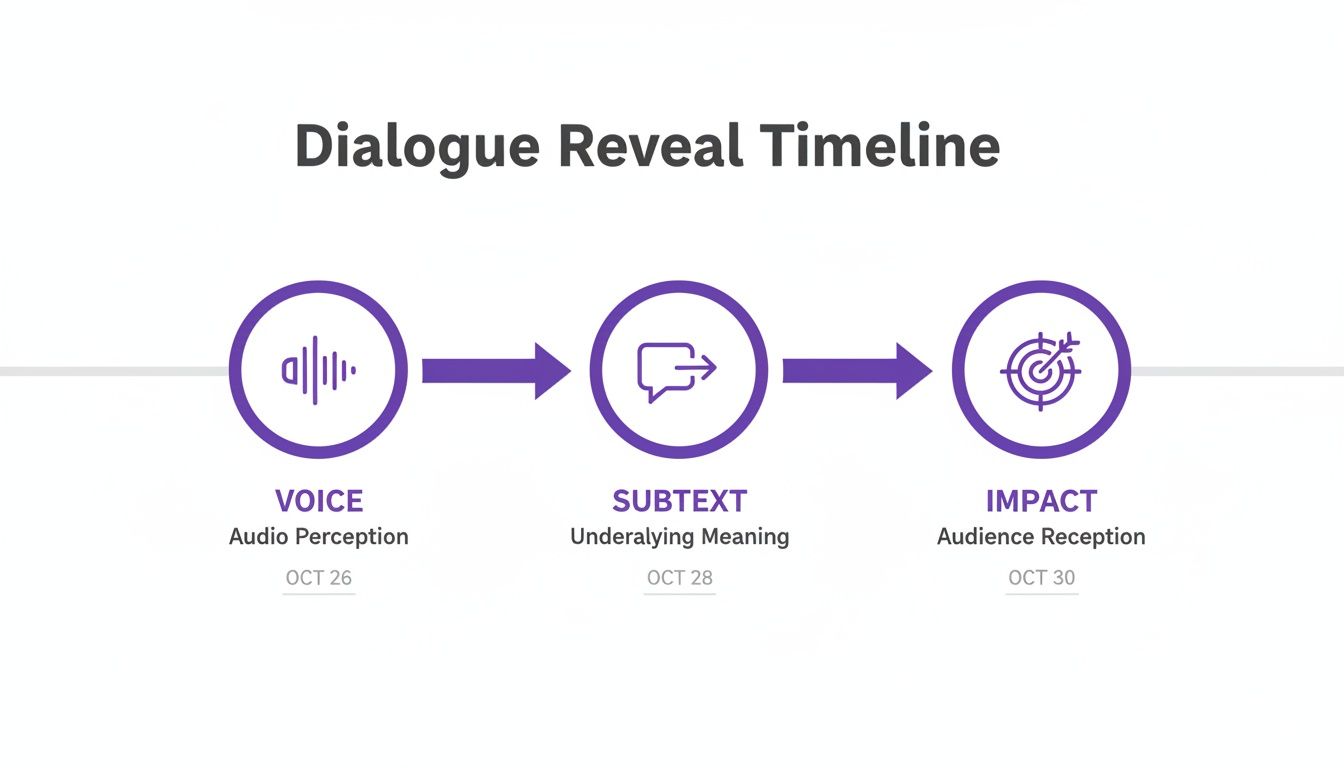
What this really shows is that a character’s true impact comes not just from what they say (voice), but from the truth simmering beneath the surface (subtext). This journey of change is what resonates so powerfully with us as readers.
It’s not just a gut feeling, either. One study found that 82% of literary classics featured dynamic character arcs, which boosted their chances of being reread by 37%. More recently, data shows that novels with strong character arcs sell 2.1 times more in popular genres. It's pretty clear: character change isn't just good writing, it's a key ingredient for success.
Keeping Your Character Consistent

When your story balloons from a few thousand words to a full-blown manuscript, the sheer volume of details becomes impossible to manage. It's a familiar panic. Did your hero break their left arm or their right one? Do they know the villain's secret identity yet?
It's these tiny inconsistencies that can yank a reader right out of the world you’ve so carefully built. This is where a simple tracking system becomes your best friend.
Maintaining continuity isn’t about stifling your creativity. It's about making your world feel real. The goal is to create a single source of truth you can check anytime, so you can spend your energy on the story, not on remembering which eye color you picked in Chapter 2.
Your Secret Weapon: The Character Bible
A character bible is just a fancy name for a living document where you stash all the crucial information about your characters. Seriously, don't overthink it. It can be a simple spreadsheet, a dedicated notebook, or a document on your computer.
The whole point is to centralize everything so you never have to second-guess yourself again. This simple tool becomes indispensable, especially if you’re writing a series where a tiny detail from book one suddenly becomes a major plot point in book three.
Your character bible should track a few key things:
- Physical Traits: Note down eye color, hair color, scars, tattoos, anything that defines how they look.
- Key Relationships: Log who they love, who they hate, and, most importantly, how those relationships evolve.
- Knowledge and Skills: Keep a running list of what they know and when they learned it. This stops them from magically knowing something they haven't discovered yet.
Inconsistent characters can create a serious disconnect, depriving the reader of an emotional reading experience. Since characters are the vehicles by which the story is told, having that disconnect can really break a story.
Keeping Track, Scene by Scene
It's not just about the static details, either. You have to track dynamic information on a scene-by-scene basis. A simple timeline can be a lifesaver here, letting you map out the progression of events to make sure your character’s emotional state and knowledge actually line up with what just happened.
After a massive, soul-crushing confrontation, your character shouldn't be chipper and fine in the next chapter. Their mood, their decisions, and their dialogue need to reflect that experience. Following these emotional beats is what makes a character arc feel earned and believable.
A lot of writers lean on specialized tools to manage these complexities. If you're tired of juggling spreadsheets and sticky notes, exploring different novel writing software can offer slick solutions for tracking timelines and character knowledge automatically.
Find a system that works for you. Once you do, you can write with confidence, knowing every little detail aligns perfectly from "Once upon a time" to "The end."
Got Questions About Writing Characters? We’ve Got Answers.
Even with the best outlines and intentions, writing a character that feels alive can be like trying to nail Jell-O to a wall. Just when you think you’ve got them pinned down, a new question pops up and the whole thing wobbles.
Let’s tackle some of the most common hurdles writers face when trying to breathe life into the people on the page.
“But Will Readers Like My Character?”
This is probably the biggest anxiety I see. We pour our hearts into these characters and we want readers to love them. But here’s a little secret I’ve learned: likable and compelling are not the same thing.
Readers will follow a deeply flawed, morally gray, or even downright infuriating character for hundreds of pages if they understand them. The key isn't making them "nice," it's making them human and their motivations clear.
Give them a goal the reader can grasp, even if they hate the methods. A mother who lies and cheats to protect her child is far more gripping than a generically good person who never faces a real, messy dilemma. Readers connect with the why behind the action.
How Do I Stop My Characters From Being Cliched?
Cliches are born from shortcuts. The orphan “chosen one” who’s instantly a prodigy, the grumpy mentor with a vague “tragic past,” they feel stale because we’ve seen them a thousand times without a fresh coat of paint.
The antidote? Specificity. You have to dig into the weird, tangible details that make a person unique.
Instead of a generic tragic past, what is the one specific event that haunts your mentor? More importantly, how does it show up in their daily life in a way we’ve never seen before?
- Maybe he refuses to eat strawberries because they were his daughter's favorite food.
- Perhaps he has a nervous tic, tapping his ring finger, that only appears when he feels he's failing a student.
- Is his gruffness a shield for a very specific fear, like being unable to protect the people he cares about?
The more you ground your characters in these small, personal realities, the further you get from cliche. Specificity is the enemy of the generic.
Perfect characters are boring. Readers connect with humanity, and humanity is messy. Flaws, quirks, and contradictions aren't weaknesses in your writing; they are the very things that make a character feel real. A character's greatest strength is often just the other side of their greatest flaw.
So, My Main Character Shouldn't Be Perfect?
God, no. Absolutely not.
A perfect character, what the internet has dubbed a "Mary Sue" or "Gary Stu," is the fastest way to get a reader to close your book. Nobody is perfect in real life, so why would we believe one exists in your story?
More importantly, a character without flaws has no room to grow. A story is fundamentally about change, and if your character starts out flawless, their journey has no stakes. They can solve any problem without breaking a sweat or paying a personal cost, and where's the tension in that?
Give them weaknesses. Let them make huge mistakes, say the absolute wrong thing at the worst possible time, and fail spectacularly. Their struggle to overcome these personal failings is what creates a compelling character arc. It’s what keeps us glued to the page, hoping they can finally get it right this time.
Ready to banish inconsistencies and make your characters unforgettable? Novelium is the first manuscript intelligence platform that acts as your co-pilot, checking for continuity errors, timeline mistakes, and character contradictions as you write. Keep your work private and your story airtight. Try Novelium for free and write with total confidence.